Dear Readers Let me tell you about:
How Money Bail Punishes Poverty and Harms Our Communities
I want to speak directly to the public about something many people never see, but thousands of people live through every day: the way our bail system punishes people for being poor, destroys families, and pressures people into guilty pleas — long before any conviction. And the harm doesn’t stop with the person behind bars. It spreads outward, landing hardest on the women who hold our communities together: mothers, grandmothers, and secondary caregivers who are forced to absorb the shock of incarceration overnight.
Freedom Should Not Depend on Wealth
In our current system, whether you go home or sit in jail before trial has nothing to do with whether you’re dangerous. It has everything to do with whether you can afford bond.
If you’re wealthy and considered a risk, you can still pay your bond and walk free.
If you’re poor and not a risk at all, you stay in jail.
That is not justice. That is a price tag on freedom.
And when you stay in jail pretrial, you lose your job, your home, your stability, and sometimes even your children — all before you’ve been found guilty of anything. Meanwhile, the people who love you most are forced into crisis mode. Grandmothers suddenly become full‑time caregivers. Mothers become financial lifelines. Secondary caregivers — aunts, sisters, cousins — scramble to keep children fed, housed, and emotionally stable.
Pretrial incarceration doesn’t just remove one person. It rearranges entire family systems.
What “Bullpen Therapy” Really Is
People inside the system use the term bullpen therapy to describe what happens when you can’t afford bond. It’s not therapy. It’s a form of punishment and pressure.
It looks like this:
- Middle‑of‑the‑night court runs
- Invasive strip searches
- Shackles, belly chains, and caged bus seats
- Long rides with people detoxing or in crisis
- Hours in crowded holding cells
- Going before a judge exhausted, stressed, and visibly restrained
This process breaks people down. It wears you out physically, mentally, and emotionally. It makes you feel hopeless. And that hopelessness is used as leverage.
But bullpen therapy doesn’t just break down the person experiencing it. It breaks down the caregivers waiting at home. Every missed call, every delayed court date, every unexplained transfer sends shockwaves through the family. Grandmothers sit up at night worrying. Mothers miss work to chase answers. Children ask questions no caregiver can fully answer.
The suffering becomes communal.
The Reality of Public Defense
If you can’t afford bond, you usually can’t afford an attorney either. Public defenders work hard, but they are overwhelmed because so many people in the system are poor.
That means:
- Less time to investigate
- Less time to prepare
- Less time to meet with clients
- Less time to fight
Meanwhile, someone who can afford bond can also afford a lawyer, can research their own case, can sleep in their own bed, and can walk into court looking like a person — not a prisoner.
And while the wealthy prepare their defense from home, poor families prepare to survive. Mothers take on extra shifts to cover commissary. Grandmothers juggle school drop‑offs and medical appointments. Secondary caregivers rearrange their lives to keep children stable.
The imbalance in resources becomes an imbalance in family survival.
How Appearance Shapes Justice
We all know about implicit bias. When a judge sees someone in shackles, sleep‑deprived, and worn down, it affects how they’re perceived. When someone walks in freely, dressed normally, with an attorney beside them, they are treated differently.
The system claims fairness, but the optics of poverty create a built‑in disadvantage.
And those optics extend beyond the courtroom. When a parent is jailed pretrial, caregivers must explain to schools, doctors, landlords, and social workers why the parent is “not available.” Poverty becomes visible in ways that invite judgment. Grandmothers are questioned. Mothers are scrutinized. Families are treated as unstable — not because of their choices, but because of the system’s choices.
Why People Plead Guilty — Even When They’re Innocent
After months or years of bullpen therapy, court runs, missed family moments, and deteriorating mental health, people plead out just to make it stop. Sometimes they use an Alford plea — saying “I’m not guilty, but I believe you have enough evidence to convict me.”
This isn’t justice. It’s coercion through suffering.
And caregivers feel that coercion too. They encourage pleas because they can’t keep holding the family together alone. Grandmothers say, “We just need you home.” Mothers say, “We can’t do another year of this.” Secondary caregivers say, “The kids are breaking down.”
The plea becomes a family decision made under duress.
The Harm Spreads Beyond the Individual
When someone is jailed because they’re poor:
- Families lose caregivers
- Children lose stability
- Communities lose workers and neighbors
- Society pays for unnecessary incarceration
- Poverty deepens and spreads
But the deepest harm falls on the women who step in to fill the gap. Grandmothers stretch fixed incomes. Mothers sacrifice their own health and stability. Secondary caregivers put their lives on hold. Children absorb trauma that follows them into adulthood.
Pretrial incarceration creates a generational domino effect — one that disproportionately impacts women, especially in communities already carrying the weight of economic inequality.
A System Designed to Keep Numbers Up
Everything I’ve described is not accidental. It is structural. It keeps incarceration numbers high, keeps court dockets full, and keeps poor people trapped in cycles of punishment.
And most people outside the system never see it.
Why I’m Sharing This
I’m sharing this because the public deserves to know what is happening in their name. People deserve to understand that money bail is not protecting them. It is penalizing poverty, breaking families, and harming communities — especially the women who hold those families together.
If we want a justice system that is truly fair, we must confront the reality that freedom should never depend on the size of someone’s bank account.
Sincerely,
Tracie
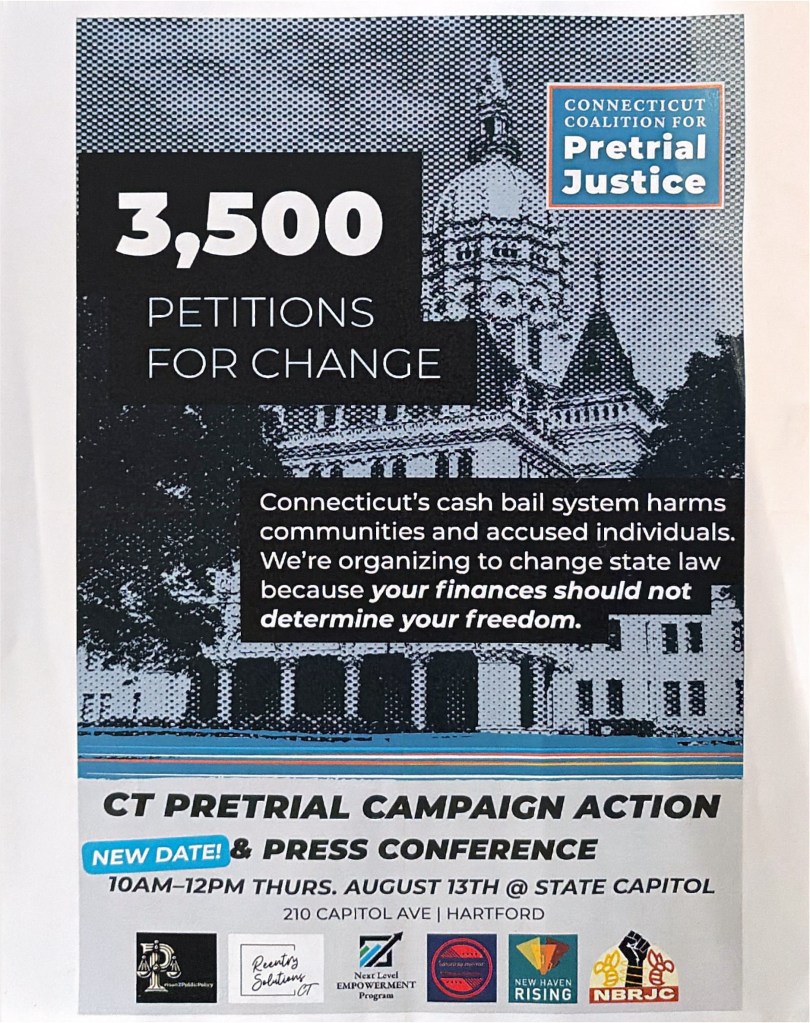
Hope to see you at the capital tomorrow!!